 020 8004 8625
 contact@dsar.ai
Breaking Down the DSAR Workflow: Where Most Delays Actually Happen
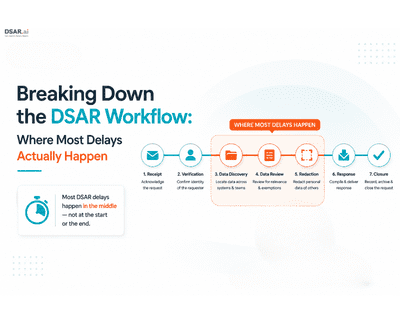
The most common challenge in DSAR processing is managing strict timelines as request volumes continue to rise.
In many cases, delays are not caused by a lack of resources, but by inefficiencies across the workflow — from intake and verification to data collection, classification, redaction, and final review.
In this blog, we’ll break down where delays actually occur across the DSAR workflow and how organisations can streamline each stage to improve turnaround time effectively.
Most DSAR delays don’t happen because teams are slow.
They happen because the workflow breaks.
Even when individual stages are handled efficiently, small inefficiencies across the process compound — pushing responses beyond GDPR timelines.
To fix delays, you need to understand exactly where they occur.
Where do delays happen in the DSAR workflow?
Delays in DSAR processing typically occur across intake, verification, data collection, classification, redaction, and review. These delays are usually caused by fragmented systems, unclear ownership, manual processes, and rework between stages.
What does a typical DSAR workflow look like?
A standard DSAR workflow includes:
- Intake – Receiving and logging the request
- Verification – Confirming the identity of the requester
- Data Collection – Locating all relevant personal data
- Classification – Identifying personal and third-party data
- Redaction – Removing exempt or sensitive information
- Review – Legal and quality checks
- Response – Packaging and securely delivering the output
While this appears linear, in practice, workflows often loop back due to errors, missed data, or failed reviews.
Why does the intake stage cause delays?
The intake stage is often underestimated.
Requests can arrive through multiple channels — email, forms, social media — making it difficult to track them consistently. Without centralisation, requests are missed, duplicated, or delayed.
Vague requests also slow things down. When scope is unclear, teams must pause to seek clarification, which directly impacts timelines.
Common issues:
- No central intake system
- Delayed acknowledgements
- Unclear request scope
What helps:
- A single intake channel
- Automated acknowledgements
- Early triage to clarify scope
Why does identity verification slow DSARs down?
Verification delays are usually process-related, not technical.
Manual checks, inconsistent requirements, and dependency on other teams create unnecessary waiting time.
In some cases, verification is repeated or escalated due to unclear standards.
Common issues:
- Inconsistent verification methods
- Delays between departments
- Lack of clear SLAs
What helps:
- Standardised verification checklists
- Defined timelines for completion
- Self-service submission where possible
Why is data collection one of the biggest bottlenecks?
Data collection is often the most time-consuming stage.
Personal data is rarely stored in one place. It exists across emails, CRMs, cloud platforms, and internal systems. Without clear visibility, teams spend significant time locating and retrieving data.
Common issues:
- Fragmented data systems
- No clear data mapping
- Sequential, manual searches
What helps:
- Maintaining a data inventory
- Parallel data retrieval instead of sequential
- Clear ownership of data sources
Why does classification create delays?
Classification becomes difficult at scale.
Unstructured data — emails, documents, chat logs — requires careful review to identify what qualifies as personal data and what needs to be excluded.
Inconsistent classification leads to errors that surface later, causing rework.
Common issues:
- Lack of standard definitions
- Human fatigue during large reviews
- Inconsistent decision-making
What helps:
- Clear classification guidelines
- Consistent criteria across teams
- Early-stage accuracy to reduce rework
Why is redaction a high-risk and slow stage?
Redaction requires both accuracy and judgment.
Teams must remove third-party data and sensitive information while ensuring the data subject still receives meaningful access.
Manual redaction, especially across large datasets, is slow and prone to inconsistency.
Common issues:
- Time-intensive manual redaction
- Inconsistent application across documents
- Legal uncertainty in edge cases
What helps:
- Defined redaction rules
- Consistent application across files
- Documentation of decisions
Why do review and response stages get delayed?
Final stages often become bottlenecks due to approvals.
Multiple layers of review, unclear ownership, and backlog pressure slow down delivery. Even when earlier stages are complete, outputs can sit waiting for sign-off.
Common issues:
- Too many review layers
- Lack of ownership
- Backlogs during peak periods
What helps:
- Clear ownership for final approval
- Parallel reviews where possible
- Standardised output formats
Why do DSAR workflows break at scale?
A workflow that works for a few requests does not hold under volume.
As DSAR volumes increase:
- manual tracking becomes unreliable
- inconsistencies become more visible
- rework increases
- bottlenecks intensify
At this stage, delays are no longer isolated. They affect the entire process.
The issue is not capacity. It is structure.
How can organisations reduce delays across the workflow?
Improving DSAR turnaround time requires reducing friction at each stage.
Key improvements include:
- centralising intake and tracking
- standardising verification and classification
- mapping data sources in advance
- reducing reprocessing loops
- assigning clear ownership at every stage
Even small improvements at each step can significantly reduce overall turnaround time.
Frequently Asked Questions
Which stage causes the most DSAR delays?
Data collection and classification are typically the biggest bottlenecks due to fragmented systems and manual processing.
Why do DSAR workflows involve rework?
Rework occurs when earlier stages, such as classification or data collection, are incomplete or inconsistent, requiring later stages to be repeated.
Can DSAR workflows be improved without increasing staff?
Yes. Most delays can be reduced by improving workflow structure, reducing inefficiencies, and standardising processes.
What is the most effective way to speed up DSAR processing?
Focusing on early-stage accuracy, clear ownership, and reducing handoffs between teams has the greatest impact.
Final Thought
DSAR delays are rarely caused by a single issue.
They are the result of friction across the workflow.
Organisations that identify and fix these friction points can significantly improve turnaround time — without increasing headcount or compromising compliance.


