 020 8004 8625
 contact@dsar.ai
AI-Generated Subject Access Requests: How to Respond (UK)
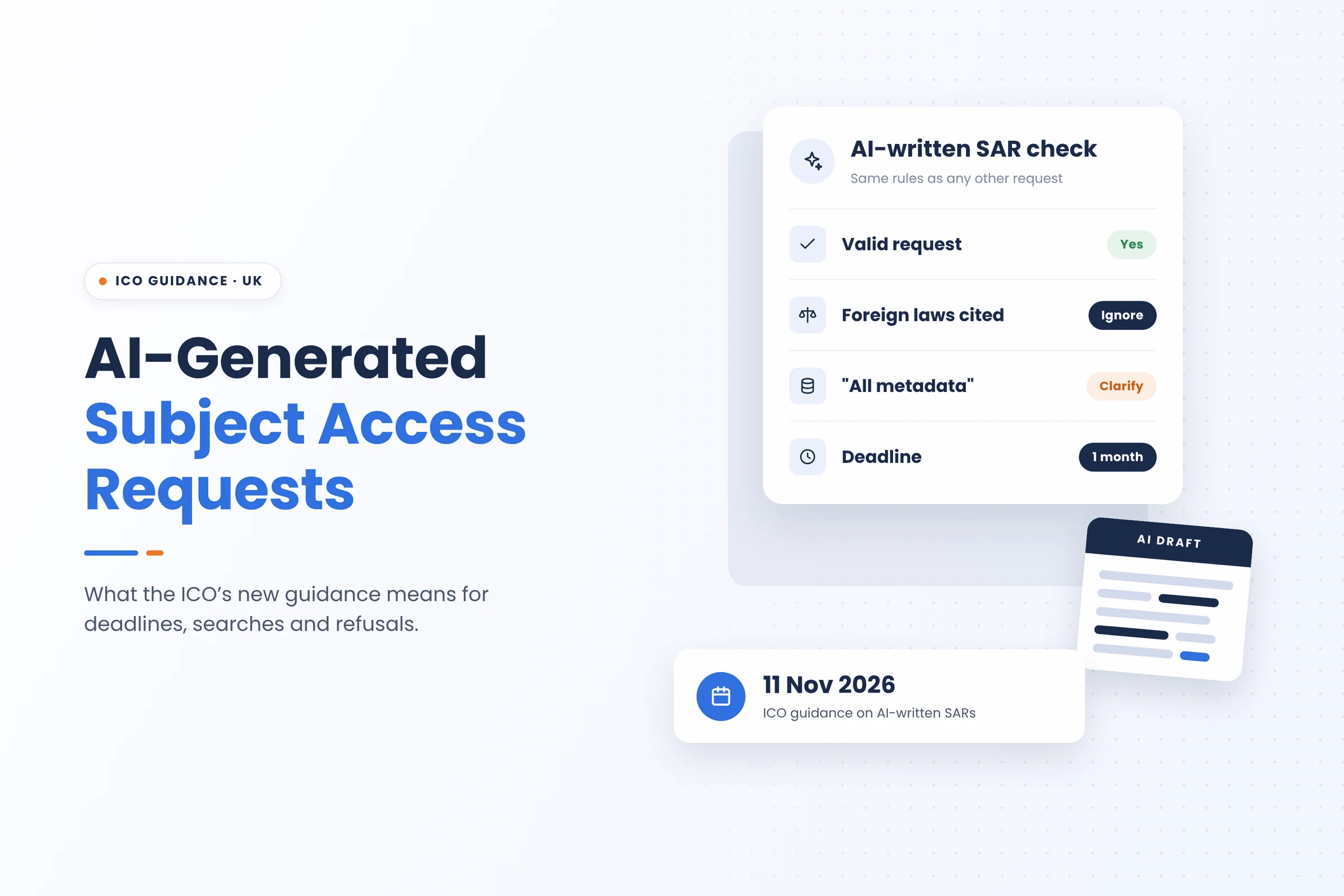
An AI-generated subject access request (SAR, also called a DSAR) is a valid request. Guidance the ICO published on 11 November 2026 says you must treat it like any other SAR. The same one-month deadline, the same reasonable and proportionate search and the same exemptions apply. Using AI does not, on its own, make a request complex, manifestly unfounded or excessive.
These requests are becoming common. Data protection complaints to the ICO rose to 76,743 in 2025/26, from 42,315 the year before, according to the ICO’s annual report. Regulators abroad are seeing the same pattern. The Berlin data protection authority logged 8,436 submissions between January and November 2025, up about 50% on 2024, and said many were clearly written with chatbots.
Is an AI-written subject access request valid?
Yes. The ICO’s guidance on SARs generated by AI compares AI to any other writing aid. The only test is whether it is clear the person wants their personal information.
A request stays valid even if it:
- cites the wrong law, or a law from another country
- quotes a court case that doesn’t exist
- misstates what the person is entitled to
- demands a shorter deadline than the law allows
A demand for a reply within seven days does not change your deadline. You must respond without undue delay and within one month of receiving the request, or of receiving any ID or proof of authority you asked for.
How can you tell a SAR was written with AI?
You don’t need to prove it, and it changes nothing about your duty to respond. Spotting the signs helps you plan the work. The ICO lists common features:
- long, repetitive or very formal wording
- requests for “all” data, including every kind of metadata
- references to irrelevant or foreign laws
- several rights bundled together, such as access, erasure and a complaint
- wrong contact details or a made-up correspondence address
Does an AI-written SAR count as complex?
Not automatically. A request is not complex just because it is long, unclear, convoluted or full of legal references. You don’t need to decode legal references that are irrelevant.
Complexity depends on the work involved. The ICO gives these examples:
- information that is hard to find, retrieve or extract
- a lot of work on exemptions, confidentiality or third-party rights
- sensitive or third-party information
- a need for specialist advice
- several rights requests submitted together
If the request is genuinely complex, you can extend the deadline by up to two further months. You must tell the person and explain why within the first month. Our guide to what makes a DSAR request complex goes further.
Do you have to search everywhere the request names?
No. AI-written requests often list backups, platforms, CCTV or call logs, sometimes including systems you don’t use. The person can suggest where information is held, but you decide the search parameters.
Your duty is a reasonable and proportionate search of the places the information is likely to be. Under the ICO guidance, you should:
- not narrow the request or make assumptions without talking to the person
- ask for clarification promptly if you genuinely can’t tell what they want
- record what you searched, what you left out and why
If you ask for clarification, the clock stops on the day you ask and restarts when you get an answer. You can’t force someone to narrow their request. Our post on the Data (Use and Access) Act changes to subject access explains both rules.
What if the request asks for “all metadata”?
A request for “all” personal information doesn’t mean you must search every type of metadata. You should consider metadata where it is likely to hold the person’s information, or where they ask for something specific.
The ICO gives examples of metadata that can be personal information:
- when a person opened a specific file
- working patterns or hours
- who a person called, and for how long
- GPS coordinates in a photo
If “metadata” is vague, you can ask what the person means. People use the word differently.
Can you refuse an AI-generated SAR as excessive?
Not because AI was used. Volume alone doesn’t make a request excessive. Some people use AI because they are unsure how to ask, or think formal wording will be taken more seriously.
A request that is clearly malicious, abusive or disruptive may still be manifestly unfounded or excessive, whether or not AI wrote it. You must be able to justify that decision. See when you can refuse a DSAR request.
What should you check before you disclose anything?
AI makes it easier to fake documents, and you stay responsible for sending data to the right person. Before disclosing, check that:
- the correspondence address matches your records, and confirm it with the person if not
- a letter of authority from a third party is genuine; if it looks AI-generated, contact the data subject directly
- you have verified identity where you have real doubt
A worked example
This is an illustrative scenario. A former employee sends a four-page request during a grievance. It cites the California Consumer Privacy Act, quotes a tribunal case you can’t find, asks for “all metadata” and demands a reply in seven days.
- Validity: it is a valid SAR. Log it and start the one-month clock.
- The foreign law and the case: ignore them. They don’t change what the person is entitled to.
- The seven days: the legal limit is one month. You can say so politely.
- The metadata: ask, promptly, whether they mean something specific, such as file access records.
- The grievance: handle it through your grievance process. It doesn’t make the SAR invalid.
- The reply: you can explain, kindly, that the request reflects some misunderstandings of the law, and set out what it does require.
What should you put in place now?
- Publish a clear page on how to make a SAR, with a contact point for help.
- Offer an optional template or example prompts, and say they are optional. You can’t stop people using AI.
- Remind people to check an AI draft before sending it, including their contact details.
- Train all staff to recognise a DSAR, and give request handlers deeper training so long, aggressive letters don’t throw them.
- Keep a written record of every search decision.
The ICO has also published advice for the public on using AI to help write a data protection request. Linking to it from your SAR page is a simple way to get clearer requests.
For the full process from receipt to response, see our UK guide to responding to a subject access request. AI-written requests usually mean bigger searches. DSAR.ai automates the search and flags personal information for redaction, so your team can focus on the scoping and exemption decisions.
Frequently asked questions
Can you reject a subject access request because it was written by ChatGPT?
No. The ICO says you must treat an AI-assisted SAR the same as any other. What matters is whether the person clearly wants their personal information.
Does an AI-generated SAR get more time to respond?
No. The deadline is one month. You can extend by up to two months only if the request is genuinely complex, not just long or wordy.
Do you have to follow the laws an AI-written SAR cites?
No. For a UK organisation, the right of access comes from the UK GDPR, whatever law the request names. You don’t need to decode irrelevant legal references.
Can you tell the requester that AI got the law wrong?
Yes. The ICO says you can explain that a request seems to reflect misunderstandings of data protection law, and what the law actually requires.
This article is general information, not legal advice. Speak to your data protection officer about individual requests.

