 020 8004 8625
 contact@dsar.ai
How to Reduce DSAR Turnaround Time Without Increasing Headcount
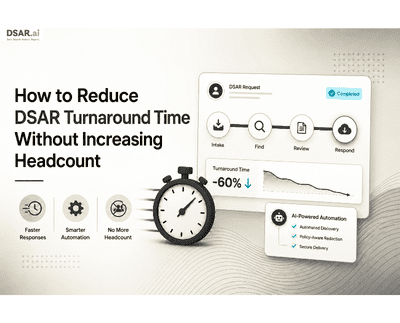
One of the most common challenges in DSAR processing is meeting strict timelines as request volumes increase.
In many cases, delays are not caused by a lack of resources, but by inefficiencies across the workflow — from data collection and classification to redaction and final review.
In this blog, we’ll break down where DSAR delays actually occur and how organisations can streamline their processes to improve turnaround time without increasing headcount.
DSAR turnaround time can be reduced by improving workflow efficiency rather than adding staff. This includes mapping data sources, reducing reprocessing, standardising outputs, controlling handoffs between teams, and prioritising requests early.
What is the DSAR response deadline under GDPR?
Under GDPR Article 12(3), organisations must respond to a DSAR without undue delay and within one calendar month of receipt.
Extensions of up to two additional months are allowed for complex or high-volume requests, but only if the data subject is informed within the first month, along with clear justification.
Regulators expect organisations to demonstrate that timelines are actively managed and delays are properly documented.
Why do DSAR requests get delayed?
DSAR delays are typically caused by inefficiencies across multiple stages of the workflow.
Data collection slows down when information is spread across multiple systems with no clear mapping. Teams spend time searching for data instead of processing it.
Classification becomes inconsistent when unstructured data is handled at scale, leading to confusion and rework.
Reprocessing loops occur when outputs fail quality checks and need to be rerun, adding significant time to the process.
Redaction becomes more complex when third-party data is not identified early, pushing effort into later stages.
Final review is often delayed when outputs are not standardised, increasing the time required for validation.
These issues rarely occur in isolation. They compound across the workflow.
What does an efficient DSAR process look like?
An efficient DSAR process is structured, predictable, and designed to minimise rework.
Instead of reacting to each request, well-functioning teams operate with predefined data locations, clear ownership at each stage, and standardised approaches to classification and redaction.
The focus is not on working faster, but on reducing friction between stages so that work progresses consistently from intake to delivery.
What bottlenecks do most teams overlook in DSAR workflows?
Some of the most impactful delays are often hidden within the process.
Rework is one of the biggest contributors. When classification is incomplete or inconsistent, files need to be revisited during later stages, creating repeated cycles of work.
Over-reviewing is another issue. Teams often add extra layers of checks to compensate for uncertainty earlier in the workflow, increasing turnaround time.
Fragmented ownership also creates delays. When responsibilities are unclear, requests stall between teams instead of progressing smoothly.
These bottlenecks are structural rather than technical.
Why do DSAR workflows fail at scale?
Processes that work for a small number of requests often fail as volumes increase.
As DSAR volumes grow, manual tracking becomes unreliable, inconsistencies increase, and review queues begin to build up.
At this point, many organisations assume they need more staff.
In reality, the process itself is not designed to handle scale. Increased volume simply exposes inefficiencies that already exist.
How can organisations improve DSAR efficiency without hiring more staff?
Map data sources in advance
Most delays begin at the data collection stage. Maintaining a clear inventory of where personal data is stored reduces search time and prevents duplication of effort.
Reduce reprocessing loops
Reprocessing adds significant delays. Improving accuracy in classification and early-stage processing reduces the need to repeat work later.
Standardise outputs early
Standardised output formats make review faster and more consistent. This reduces the time required for validation and final delivery.
Control handoffs between teams
Each transition between IT, compliance, and legal introduces delay. Clear ownership and defined responsibilities reduce waiting time and miscommunication.
Prioritise requests early
Not all DSARs are equal. Identifying complex or high-risk requests early allows teams to allocate time effectively and plan for extensions where needed.
How can organisations build DSAR processes that scale?
To consistently meet DSAR timelines, processes need to be designed for scale rather than volume spikes.
This involves reducing reliance on individual judgment, ensuring consistency across requests, and eliminating unnecessary steps.
Small improvements, such as better data organisation and clearer workflows, can significantly improve turnaround time.
Over time, these improvements compound and create a more resilient process.
Frequently Asked Questions
Can DSAR timelines be extended under GDPR?
Yes, organisations can extend the response timeline by up to two additional months for complex or high-volume requests, provided the data subject is informed within the first month and given a valid reason.
What is the biggest cause of DSAR delays?
The most common causes are fragmented data collection, inconsistent classification, reprocessing loops, and unclear ownership across teams.
Is hiring more staff the best way to reduce DSAR delays?
Not necessarily. In many cases, improving workflow efficiency has a greater impact than increasing headcount.
How do organisations handle high DSAR volumes effectively?
By structuring workflows, standardising processes, and reducing inefficiencies across each stage of the DSAR lifecycle.
Final Thought
Reducing DSAR turnaround time is not about working faster.
It is about removing friction from the workflow.
When processes are structured correctly, organisations can handle higher volumes, maintain compliance, and meet deadlines without increasing headcount.


