 020 8004 8625
 contact@dsar.ai

What Is DSAR.ai? How Our Platform Handles Subject Access Requests
In a multi-academy trust, the trust is the data controller for its schools. So a subject access request (SAR), also called a data subject access request (DSAR), made at any academy is a request to the trust. The one-month deadline starts when any member of staff receives it, at any site.
The way to stay on time as a trust grows is one process: one log, one named lead, and the same rules in every school.
According to the DfE’s Schools, pupils and their characteristics release, 60.4% of pupils in England attended an academy in January 2026. And DfE analysis shows that at 1 December 2025, 83.9% of secondary academies were part of a multi-academy trust.
Who is the data controller in a multi-academy trust?
The trust. The DfE’s academy trust governance guide says a multi-academy trust is a single legal entity, with one board accountable for all its academies.
The DfE’s data protection guidance for schools confirms that for most personal data, the school or the multi-academy trust is the data controller.
In practice, the trust answers for every response, whichever school sends it. A request made at one school about records held at another is still one request.
How do subject access requests reach a trust?
Through any door. The DfE’s guidance on dealing with SARs says people can make a request to anyone who works at the organisation, including teachers, support staff and volunteers. Requests can be spoken or written.
The ICO’s guide to subject access adds that a request can come through social media and doesn’t need any particular wording.
In a trust, a request could land at any school’s reception, in a headteacher’s inbox or with central HR. The clock starts there, not when the central team hears about it.
What does one SAR process across a trust look like?
One log, one lead and one set of rules. ICO guidance on preparing for SARs recommends a specific person or central team to handle requests, with more than one member of staff who knows how to deal with one, so there’s cover when someone is away.
- One log. Every request from every school goes on one central log: the date received, the due date, any pauses and why, the systems searched, and what was withheld and why. The DfE says to keep a record of the SAR process from start to finish.
- One lead. The data protection officer (DPO) or central team owns every response. A named data protection lead in each school logs requests and passes them on the same day.
- One set of redaction rules. A single written approach to information about other people, and one sign-off step before anything is released. The DfE says to record decisions about third-party information and keep both redacted and unredacted copies.
- One search map. An information asset register showing where each school keeps personal data: the management information system, email, cloud drives, CCTV and paper archives. Since the Data (Use and Access) Act, searches must be reasonable and proportionate, and the DfE’s DUAA checklist for schools asks schools to record the scope of each search.
- One set of supplier terms. Under Article 28(3)(e) of the UK GDPR, a contract with a processor must require it to help the controller respond to requests. Check this once, at trust level.
- One complaints route. Since 19 June 2026, section 164A of the Data Protection Act 2018 lets people complain directly to the controller. The DfE says complaints must be acknowledged within 30 days. In a trust, a complaint about how one school handled a request is a complaint to the trust.
These gaps are common. In the ICO’s November 2020 review of SAR handling in education, which included multi-academy trusts, only 62% of the establishments kept a central log of requests. In 75%, contracts with data processors did not clearly set out SAR duties, or the processors were not aware of them.
Where things worked, a trust’s DPO was supported by a data protection lead in each school. For the law changes behind these steps, read our summary of Data (Use and Access) Act changes to subject access.
What should happen when a new school joins the trust?
Bring it into the trust’s process when it joins, not at the next policy review. Here is a checklist for the first weeks:
- Name the school’s data protection lead and a second person for cover.
- Brief all staff, volunteers and governors on spotting a request and passing it on the same day.
- Add the school to the central log. Move any open requests across with their original dates and deadlines, so nothing slips in the handover.
- Map the school’s systems into the trust’s information asset register.
- Check the school’s supplier contracts for SAR assistance terms, and bring them in line with the trust’s.
- Replace any local SAR wording on the school’s website and privacy notice with the trust’s, including how to complain.
- Retire local templates and point staff to the trust’s letters and redaction rules.
- Confirm who checks the data protection inbox during the school’s holidays.
Do deadlines change across schools with different term dates?
No. A SAR must be answered within one calendar month of receipt, whatever the school’s calendar. The DfE is clear that schools can’t extend a response because it’s the school holidays.
The month can pause while you wait for ID, proof of authority or a genuine clarification. A complex request can be extended by up to two more months, if you tell the requester why within the first month. For a closer look at holiday cover, read our guide to subject access requests in school holidays.
One rule differs by school type. ICO guidance on education information says the parent’s separate right to see a child’s educational record, with its 15 school day limit, applies in England and Wales only to maintained schools. In an academy trust, a parent’s request for their child’s information is handled as a SAR.
A worked example: one request, two schools
A parent tells a teaching assistant at a trust secondary that they want “everything you have on my son”. He went to a primary school in the same trust. One process handles it like this:
- The teaching assistant notes the request and passes it to the school’s data protection lead that day.
- The lead adds it to the central log. The due date is set from the day the assistant heard it.
- The central team confirms parental responsibility and whether the son is old enough to make the request himself.
- Using the search map, the team searches both schools’ systems and the trust’s central records.
- One set of redaction rules is applied to both schools’ records, and one person signs off.
- The trust sends one response. It explains how to complain to the trust and to the ICO.
Frequently asked questions
Is each academy in a trust a separate data controller?
No. A multi-academy trust is a single legal entity, so the trust is the controller for the personal data its schools hold.
Does each academy need its own data protection officer?
No. Article 37(3) of the UK GDPR allows one DPO to be designated for several public authorities or bodies, taking account of their structure and size.
Can a school in a trust answer a subject access request itself?
Yes, if the trust’s process allows it. The trust is still responsible, so the request should still go on the central log and follow trust rules.
Does the deadline restart if a request goes to the wrong school?
No. The request is made to the trust, so the month runs from when any member of staff received it.
Do parents at academies have a right to see the educational record?
No. In England, that separate right applies only to maintained schools, so in an academy a parent’s request is handled as a SAR.
Next steps
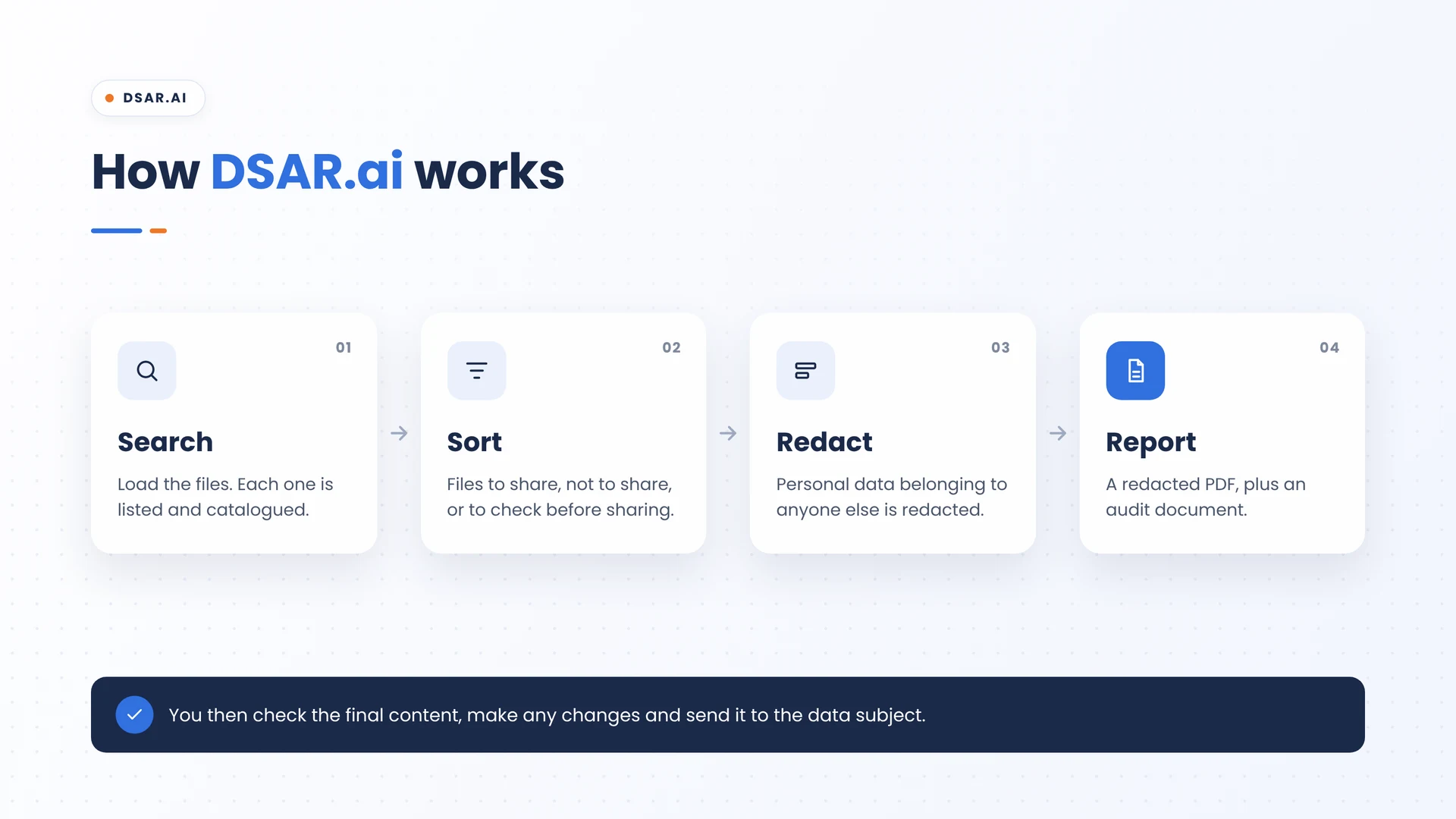
New to the process? Start with our step-by-step guide to responding to a subject access request, or read our overview of subject access requests in schools. If you’re building one process across a growing trust, see how DSAR.ai works.
This article is general information for UK schools and academy trusts, not legal advice.

